.jpg)
Why the Current Viral Evolutionary Dynamics Suggest That SARS-CoV-2 Is Approaching an Evolutionary Phase Transition
The following Substack article is a continuation of my previous exchange with an epidemiologist (see: https://voiceforscienceandsolidarity.substack.com/p/the-myth-of-endless-fine-tuning-and), who challenges my theory of a phase transition toward an entirely new coronavirus capable of circumventing the adaptive immune responses of a substantial proportion of the C-19-vaccinated population in highly C-19-vaccinated societies.
For clarity, I have placed an "E:" at the beginning of passages in which I quote the epidemiologist whereas my own responses are preceded by "G:".
This exchange is just one of many examples illustrating the one-sided perspective through which many scientists fail to understand the impact of mass vaccination on the evolutionary dynamics of the SC-2 pandemic. Yet it also demonstrates that meaningful scientific dialogue remains possible when there is a willingness to engage with competing hypotheses rather than dismiss them outright.
There is clearly a need for greater education and, perhaps even more importantly, for a genuine willingness to consider analyses that challenge the prevailing mainstream narrative. Scientific progress rarely emerges from consensus alone. More often, it advances through the rigorous examination of alternative explanations, especially when established frameworks struggle to account for an increasing number of observations.
Whether one ultimately agrees with my conclusions or not, I believe the continuing inability of conventional models to explain the current evolutionary trajectory of SC-2 should encourage a broader and more open-minded discussion of the mechanisms that may be driving this unprecedented immune escape pandemic.
E: “It seems to me that there is a question of, under the current metastable circumstances of increasingly narrowing immune escape pathways, will a limit eventually be reached where without some major phase transition mutation, the virus eventually dies out. This would be a contest between available new incremental mutations occurring, and existing immune repertoires combatting them. I don't see it as a given that the mutation rate and possible mutation combinatorics are automatically strong enough to combat population immune suppression for all time. Maybe only strong enough in the first few years or decades of a pandemic but maybe not eventually.
The second thing is that over time, more unvaccinated children will enter the adult population and their initial frequently asymptomatic immune responses will provide a different immune milieu for the virus mutation escape process.
What you are suggesting about a radical mutation that achieves strong immune escape theoretically can happen, but I don't see any evolutionary force per se that would push it, and we don't know what it would take statistically in antigen combinatorics to arrive at some effective radical combination. With perhaps 108 mutations occurring in each infected individual and some 1010 or more infections occurring worldwide, that would be 1018 mutation combinations, from which maybe about 1% (1017) escape. The virus spike protein has about 1300 (103.1) mutable loci. So this might account for all possible combinations of 17/3.1 = 5.5 loci. A radical mutation combination would therefore have to include functionally beneficial changes in more than 6 spike loci.
Certainly, viral variants with way more than 6 variant spike loci have occurred. But most likely only a few of their variant loci were needed for immune escape and the rest were passive travelers. For a radial variant, it would need 6 or more truly functional variant loci. Possible theoretically, but has not yet occurred in 6 years of viral evolution, and if the immune "loopholes" keep narrowing, it is also theoretically possible that the virus might fail before it happens”.
G: Thank you for engaging with the argument. However, I believe you are still viewing the problem primarily through the lens of mutation statistics rather than through the lens of host-virus evolutionary dynamics.
The first question I would ask is: how exactly do you envision the virus dying out in a population that has failed to generate transmission-curtailing herd immunity?
As I have repeatedly argued, a pandemic caused by an acute viral infection can only transition into endemicity when herd immunity sufficiently suppresses viral transmission and replication. In highly C-19-vaccinated populations, this has not happened. The virus continues to circulate, replicate, and evolve. Consequently, the evolutionary process remains active.
The key driver of immune escape is not the mutation rate itself. Mutations occur continuously. What determines evolutionary success is the selective pressure exerted by the host population. In the current chronic phase of the immune escape pandemic, increasingly transmissible viral lineages and increasingly broad but suboptimal adaptive immune responses are temporarily keeping one another in balance. This is what I refer to as a metastable state. However, metastability should not be confused with stability.
What we currently observe is that conventional adaptive pathways are yielding diminishing returns. Due to structural and steric constraints within the Spike protein, the virus increasingly requires multiple coordinated amino-acid changes to achieve the same incremental fitness gains that previously required only one or two mutations. This explains why transmissibility gains are becoming progressively smaller and why unrelated variant families are converging on similar functional phenotypes.
But this does not mean the virus is running out of evolutionary options. It merely means that one class of adaptive solutions is becoming exhausted.
For years, I have argued that the focus on amino-acid substitutions within Spike is excessively narrow. Evolution is not restricted to the pathways that epidemiological models happen to include. I have repeatedly outlined how changes in glycosylation patterns, for example, could dramatically alter the interaction between the virus and the immune system by facilitating mechanisms such as trans infection, lectin-mediated attachment, enhanced fusion competence, or cell-to-cell spread.
Such a phenotype would undoubtedly carry a substantial intrinsic fitness cost under ordinary circumstances. However, fitness is context-dependent.
If immune pressure on conventional transmission pathways continues to increase, a lineage capable of bypassing vaccine-primed adaptive immune responses could ultimately gain a competitive advantage despite paying such a cost.This is not because some mysterious "evolutionary force" pushes the virus in that direction. It is simply Darwinian selection acting on whatever phenotype happens to be most successful in the prevailing immune environment. That is exactly how evolution works.
You also suggest that over time unvaccinated children entering the adult population could gradually shift the population immune landscape.
The question is whether demographic turnover can occur rapidly enough to outpace viral evolution. I find that highly unlikely.
In most highly C-19-vaccinated countries, annual birth rates typically replace only about 1–2% of the population per year. Even under highly favorable assumptions, it would take several decades before a substantial fraction of the population consisted of individuals whose immune histories were dominated by natural exposure rather than vaccination. By contrast, SC-2 generates new generations every few hours, infects millions of hosts, and continuously explores new evolutionary possibilities. The timescales are simply not comparable.
Furthermore, several recent observations suggest that younger age groups are becoming proportionally more represented among infections caused by highly transmissible circulating variants. If this reflects increasing exposure of children to these variants, then the contribution of naturally acquired immunity to transmission-curtailing herd immunity may be delayed rather than accelerated.
Most importantly, I think your argument still assumes that viral adaptability is primarily a question of combinatorial amino-acid mutations within Spike.
That assumption is precisely what I question. The history of biology repeatedly shows that complex adaptive systems rarely remain trapped indefinitely within a narrowing corridor of increasingly marginal gains. When conventional adaptive pathways become saturated, systems often reorganize around fundamentally different solutions. That is why I find the current situation more reminiscent of a snow cornice hanging over a steep mountainside than of a virus quietly approaching extinction. One can always hope the snow melts before the avalanche is triggered. But hope is not a mechanism.
Likewise, I have yet to see a convincing biological mechanism explaining how a virus that continues to replicate globally, continues to generate new variants, continues to produce saltation events, and continues to face ongoing immune selection pressure will simply "run out of options" and disappear.
Darwin's principle remains as relevant today as ever:
It is not the strongest that survives, nor the most intelligent, but the one most adaptable to change.
The crucial question is therefore not whether the virus can continue mutating. It can.
The question is whether the host population can adapt more rapidly than a pathogen that generates new generations every few hours while continuously being selected in billions of hosts. That, in my view, is where the burden of proof lies.
E: I take your point. It would be good to have a sense of whether any other respiratory viruses have ultimately given up their main or original mutation repertoire and shifted to a more mutation costly but remaining functional paradigm.
G: The crucial point is that the issue is not whether SARS-CoV-2 will suddenly discover an entirely new mutational repertoire. The issue is the evolutionary landscape in which those mutations are being selected. The current situation is unprecedented because we have never before exposed large populations to non-sterilizing vaccines during the active circulation of a pandemic virus causing an acute self-limiting infection (ASLVI). Had the same strategy been applied to any other pandemic of a virus causing ASLVI, we would have observed similar evolutionary dynamics.
What matters is not the virus per se, but the selective environment in which it evolves.
A virus does not "choose" its mutations. Mutations arise continuously. What determines their success is the immune landscape they encounter. The unique feature of highly C-19-vaccinated populations is that repeated vaccine-breakthrough infections (VBTIs) have progressively shaped that landscape through repeated recall of vaccine-primed adaptive immune responses. This has generated a type of immune conditioning for which we have no historical precedent at the population level. As I have argued in several Substack articles and in my online courses, the relevant selective pressure is no longer narrowly antigen-specific. It has gradually broadened while simultaneously becoming less effective at preventing transmission. This is precisely why the acute phase of the SC-2 pandemic has transitioned into a chronic immune escape pandemic rather than a transition toward stable endemicity.
Consequently, the relevant question is not:
"Can the virus still find mutations?"
but rather:
"Which mutations are being selected in an immune environment that has itself been profoundly modified by mass vaccination and repeated breakthrough infection?"
That is where my analysis differs from conventional epidemiological reasoning.
E: The current vaccines only dealt with the spike protein so mutations elsewhere would be expected at best to be constrained only by post-infection natural immunity rather than vaccine immunity.
G: I am not sure I agree with your suggestion that mutations outside the Spike (S) protein would primarily be constrained by natural immunity rather than vaccine-induced immunity.
This overlooks the dynamic consequences of immune refocusing. Repeated VBTIs do not simply maintain S-directed immune responses. Over time, they progressively recruit broader adaptive immune responses directed against increasingly conserved epitopes, including epitopes located in non-S proteins. In other words, although the original vaccines exclusively targeted the S protein, the immune landscape that subsequently evolved no longer does. Moreover, unlike the S protein, non-S proteins have not been reported to experience structural and spatial constraints under sustained immune selection pressure.
More importantly, however, I do not consider post-infection immunity in previously unvaccinated individuals to be equivalent to vaccine-primed immunity when it comes to driving viral evolution.
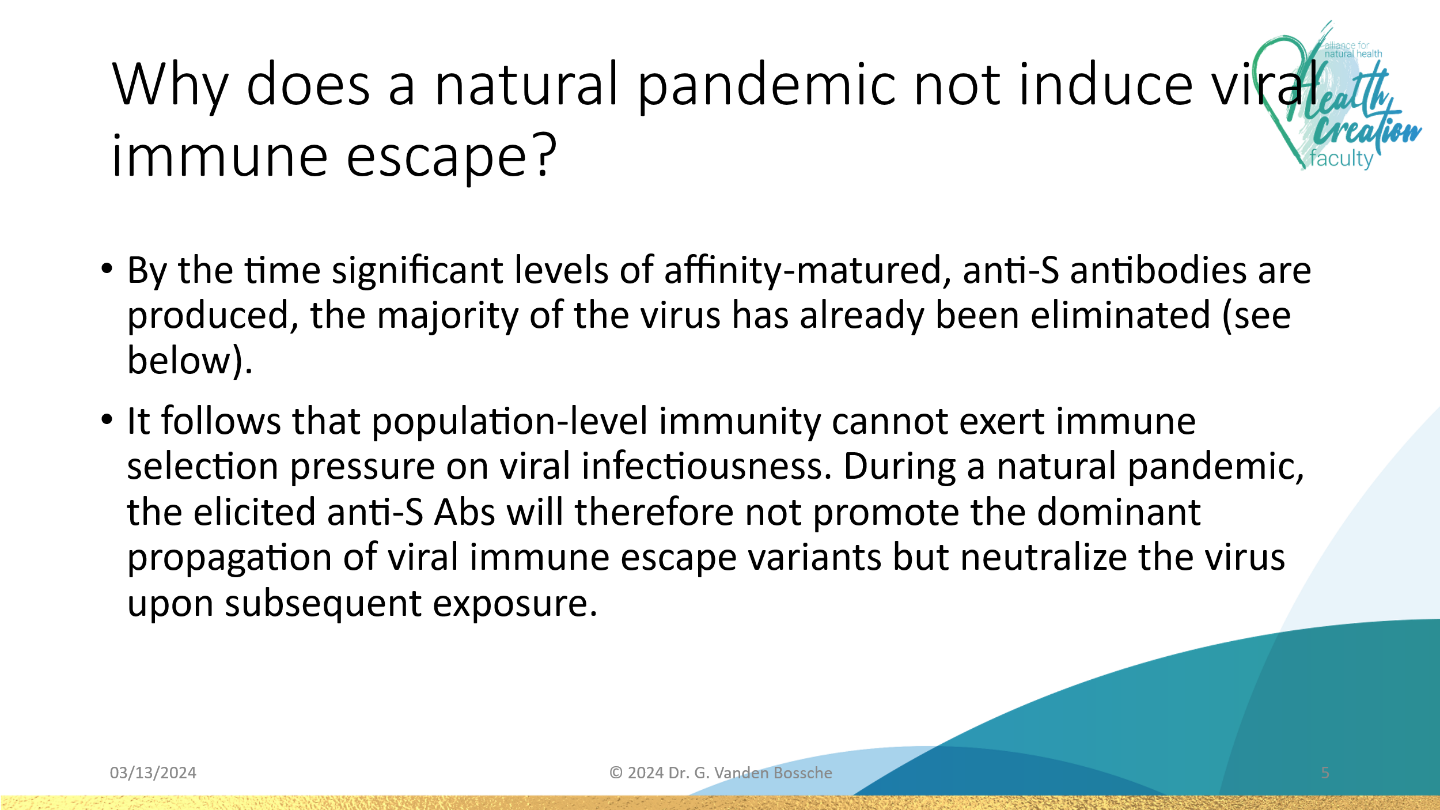
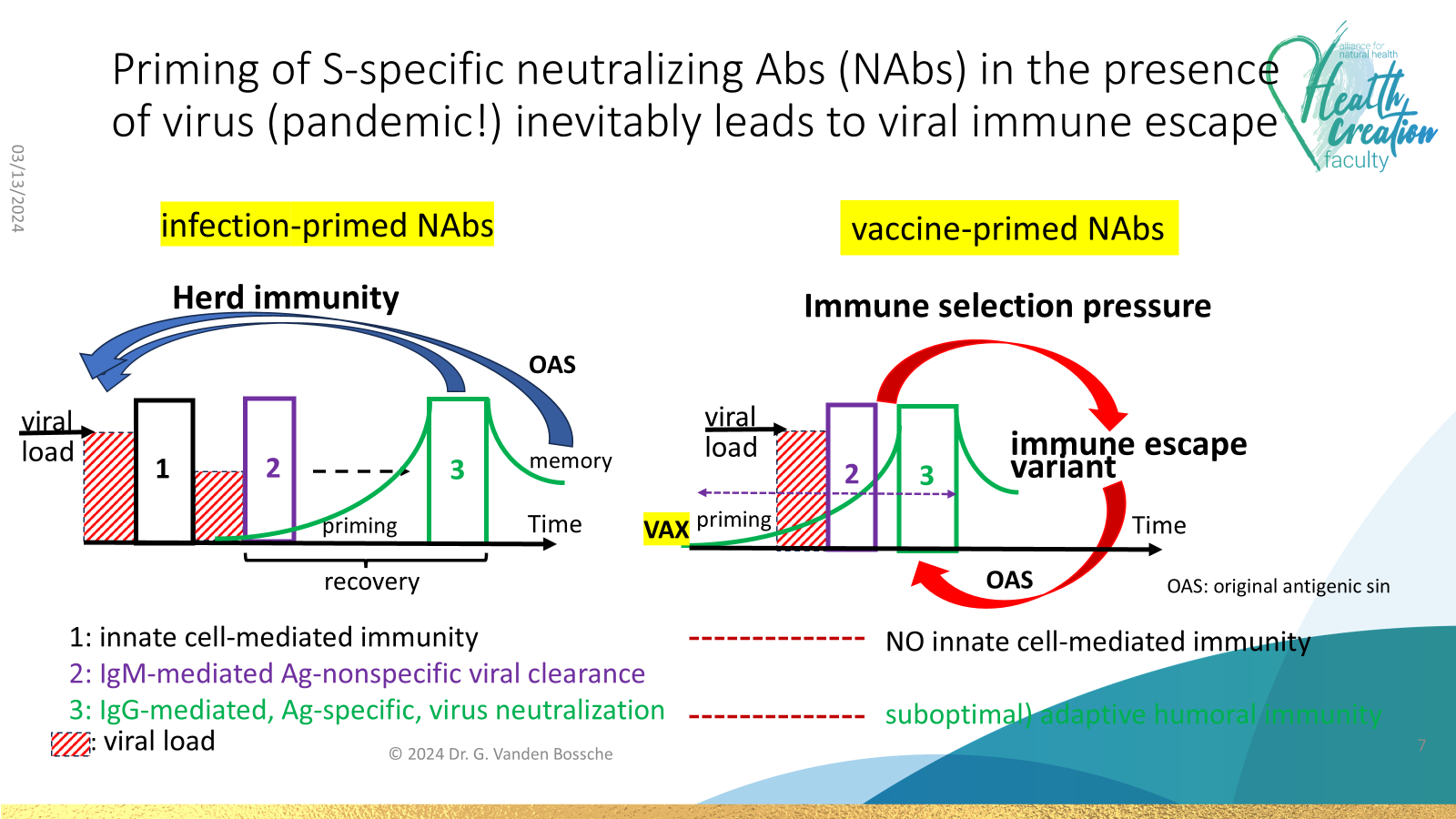
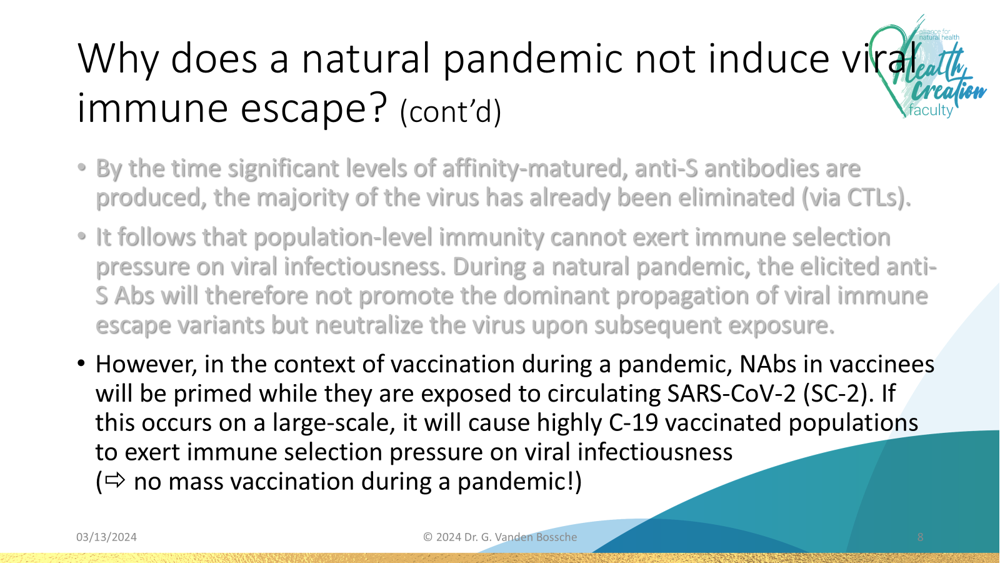
As I have explained in my online courses and Substack articles, natural infection in immunologically naïve individuals typically does not exert the same type of antigen-specific immune pressure on actively replicating virus. This is because innate immune mechanisms and early cellular responses eliminate the bulk of the viral load before substantial levels of S-specific neutralizing Abs are generated. This is fundamentally different from the situation created by vaccine-primed adaptive responses or repeated recall thereof during VBTIs (see powerpoint slides of my course at the bottom of this e-mail).
Consequently, natural infection contributes to the development of protective population immunity without exerting the sustained immune selection pressure that drives viral immune escape. This distinction is key to understanding why previous natural pandemics caused by ASLVIs generated transmission-curtailing herd immunity and eventually transitioned into endemicity. Herd immunity curtailed transmission before immune escape became the dominant evolutionary driver. In contrast, vaccine-modified pandemics may instead evolve into prolonged immune escape pandemics.
The situation we are dealing with today is, therefore, fundamentally different: The chronic phase of the immune escape pandemic is not being sustained because the virus possesses some magical capacity to mutate forever. It is being sustained because the virus continues to encounter an immune landscape that favors variants capable of overcoming increasingly broad but still suboptimal adaptive immune responses. That is why one should not view the current evolutionary dynamics as a simple extension of what we have seen with influenza or other endemic respiratory viruses.
E: The risks you describe are essentially quantitatively unknowable.
G: I don’t think the relevant question is whether the risks I describe are precisely quantifiable today.
Many phase transitions in complex systems are difficult to predict quantitatively before they occur. The important question is whether the underlying conditions for such a transition are accumulating.
When I look at:
- the prolonged co-circulation of unrelated variant families,
- the emergence of repeated divergent saltation variants,
- the increasing convergence of viral phenotypes,
- the diminishing returns of conventional immune escape pathways and
- the absence of transmission-curtailing herd immunity,
I see evidence of a system that remains evolutionarily active but increasingly constrained. That is why I describe the current state as metastable.
The virus is not running out of mutations. It is running out of easy evolutionary solutions. And that is precisely why I believe the most important evolutionary event may still lie ahead rather than behind us.
E: It seems that we can only wait and watch.
G: That is unfortunately what experts and public health authorities have been doing all along. Yet there may still be a window of opportunity to set things right. Viral circulation has arguably never been this low since the pandemic began. In my view, options worth considering could include short-term mass administration of antivirals or strategies aimed at enhancing the host’s innate immune defense, such as BCG vaccination.
The problem is that both approaches remain largely theoretical in practice. The necessary scientific understanding of the ongoing host–virus evolutionary dynamics is lacking and so is the political willingness to implement coordinated measures on a population-wide scale.
E: Yes, I agree that the selection side of the mutation process determines what escapes and gets established. This is my normal understanding in more general epidemiologic terms so of course it applies at the immune responses level.
I suspect that s protein mutations have been evolutionarily more effective in escape mechanisms and thus that factors of replication mass producing s protein mutations have also been selected for. Perhaps that is why mutations in other external structures seem to be much less frequent, because they haven't yet needed selection for propagation benefit. I think your point is that as the s protein mutation process becomes increasingly narrowed, other mutations may end up getting selected if they have propagation benefit, and these of course have no vaccine-based immunity., and there are not enough people with original natural post-infection immunity.
Do you have any particular antivirals in mind? Some like tamoxifen are virtually useless and have appreciable side effects.
G: I am pleased to say that, this time, I can agree with you completely.
Very few scientists take a genuine interest in the glycobiology of viruses. That has always puzzled me. After all, the remarkable role of glycosylation is described in virtually every virology textbook. Glycosite mutations, for example, can help a virus evade adaptive immunity by adding, removing or repositioning glycans that physically shield Ab and Tc epitopes from immune recognition. Unlike amino acid substitutions, which modify the epitope itself, glycans act as a form of molecular ‘camouflage’, preventing immune effectors from accessing their targets. As a result, the virus may reduce the effectiveness of pre-existing adaptive immune responses without necessarily having to alter large portions of its protein sequence. In addition, glycan remodeling can promote alternative modes of viral spread, such as lectin-mediated attachment, trans infection or cell-to-cell transmission, thereby reducing reliance on pathways that are heavily targeted by adaptive immunity.
What makes this particularly interesting is that SC-2 is already estimated to have approximately 30–40% of its S surface covered by glycans. These glycans therefore constitute an enormous potential reservoir for immune evasion. On the other hand, a substantial remodeling of the viral glycosylation profile would undoubtedly come at a significant intrinsic fitness cost. Consequently, such evolutionary potential is unlikely to be exploited unless the immune pressure collectively exerted on the virus becomes sufficiently intense for one or more glycosite mutations to provide a meaningful competitive advantage within the hostile immune landscape of highly C-19-vaccinated populations.
Hence, what is really important for understanding a potential evolutionary phase transition is not whether SC-2 can continue generating additional amino acid substitutions. Rather, the key question is how much additional glycosylation or glycan remodeling remains structurally feasible before essential S functions become compromised. HIV, for example, demonstrates that a virus can remain highly viable while carrying a glycan shield substantially larger than that of SC-2. This does not mean that SC-2 will necessarily evolve in the same direction. However, it does indicate that there remains considerable biological space between the current SC-2 glycan shield (~30–40%) and the degree of glycan shielding that a virus can theoretically tolerate under sufficiently strong immune selection pressure.
From the perspective of the current metastable equilibrium between the virus and host population immunity, one could therefore argue that the central question is not whether SC-2 can still generate additional amino acid substitutions. Rather, it is whether increasing immune pressure and diminishing returns from conventional immune escape will eventually favor a qualitatively different adaptive strategy ─ one that relies more heavily on glycan-mediated phenotypic innovations capable of fundamentally reshaping the host-virus interaction landscape by shielding critical viral epitopes from adaptive immunity while simultaneously enhancing viral entry, trans infection, and cell-to-cell spread.
Whether the current population-level immune pressure is capable of driving SC-2 in such a direction is, of course, impossible to prove at present. Yet there is at least one person on this planet who is firmly convinced that it will...
As intensely as I have immersed myself in the evolutionary dynamics of a virus being relentlessly driven by a collective vaccine-primed adaptive immune response, I must admit that I am less familiar with the practical question of which antiviral agents would be most suitable for eliminating the virus while its circulation remains historically low. That said, several antiviral candidates could reasonably be considered. However, from a purely theoretical epidemiological perspective, synchronization and mass administration may ultimately matter more than modest differences in antiviral potency when the objective is interruption of transmission rather than treatment of individual patients. In many infectious-disease control programs, timing and coverage can be just as important as the efficacy of the intervention itself.
Even if unvaccinated individuals were willing, out of solidarity (!), to participate in such a campaign, it seems rather utopian to expect public health authorities or officially recognized experts to initiate or support a coordinated population-wide effort of that kind.
Unfortunately, acknowledging that the current viral burden may represent a unique window of opportunity would require first acknowledging that the pandemic is not over and that the evolutionary dynamics unfolding before our eyes are not those of stable endemicity!

Geert Vanden Bossche received his DVM from the University of Ghent, Belgium, and his PhD degree in Virology from the University of Hohenheim, Germany. He held adjunct faculty appointments at universities in Belgium and Germany. After his career in Academia, Geert joined several vaccine companies (GSK Biologicals, Novartis Vaccines, Solvay Biologicals) to serve various roles in vaccine R&D as well as in late vaccine development.
Geert then moved on to join the Bill & Melinda Gates Foundation’s Global Health Discovery team in Seattle (USA) as Senior Program Officer; he then worked with the Global Alliance for Vaccines and Immunization (GAVI) in Geneva as Senior Ebola Program Manager. At GAVI he tracked efforts to develop an Ebola vaccine. He also represented GAVI in fora with other partners, including WHO, to review progress on the fight against Ebola and to build plans for global pandemic preparedness.
Back in 2015, Geert scrutinized and questioned the safety of the Ebola vaccine that was used in ring vaccination trials conducted by WHO in Guinea. His critical scientific analysis and report on the data published by WHO in the Lancet in 2015 was sent to all international health and regulatory authorities involved in the Ebola vaccination program. After working for GAVI, Geert joined the German Center for Infection Research in Cologne as Head of the Vaccine Development Office. He is at present primarily serving as a Biotech / Vaccine consultant while also conducting his own research on Natural Killer cell-based vaccines.
Email: info@voiceforscienceandsolidarity.org
.svg)

.jpg)