
Author: G. Vanden Bossche, DVM, PhD October 3rd, 2026
Is SARS-CoV-2 Starting to Leave Its ‘Stable’ Phase?
A plain-language look at PJ.2.1, the strange new family tree of variants, rising wastewater signals, and why I do not think this is simply another seasonal wave.
For months, I have argued that the apparent stability of SARS-CoV-2 (SC-2) should not be confused with true evolutionary stability. The virus has continued to diversify under immune pressure but the gains and losses caused by different mutations may have balanced each other sufficiently to keep the overall situation looking relatively stable. I call this a metastable phase.
What concerns me now is that several things are changing at the same time. We are seeing a much more branched viral family tree, the appearance of unusual saltation variants such as PJ.2.1, signs that some of these variants have extra fitness to 'spend' on future immune escape, and renewed increases in virus circulation in several regions.
This does not prove that the major evolutionary transition I have warned about has begun. Severe disease has not clearly increased. But the current pattern looks more interesting to me than an ordinary seasonal rebound.
When a virus evolves in a simple step-by-step way, one dominant branch replaces another. The current SC-2 picture is much messier. Many branches are being explored at the same time.
Ryan Hisner highlighted this very clearly with PJ.2.1. In July he pointed to how far PJ.2.1 sits from other current lineages in the Neher/Roemer BA.2.86 tree. In an August update, after adding new New York sequences, he wrote: 'The whole PJ tree is completely unlike what you typically see.'
That does not automatically mean danger. But it does mean the virus is still exploring unusual parts of its evolutionary landscape rather than simply fine-tuning one settled endemic form.
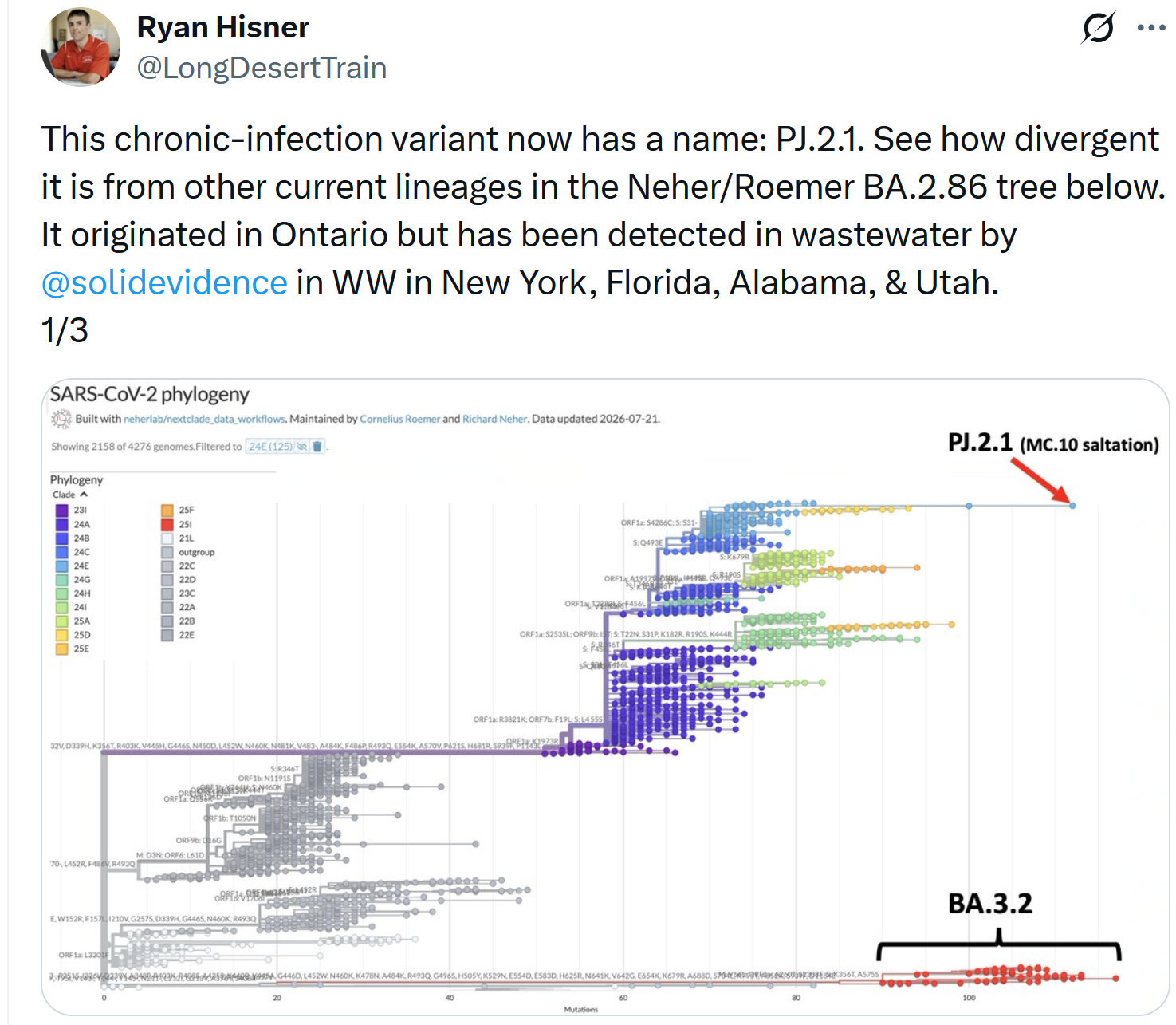
Figure 1A. Original Neher/Roemer BA.2.86 phylogeny highlighted by Ryan Hisner, 21 July 2026
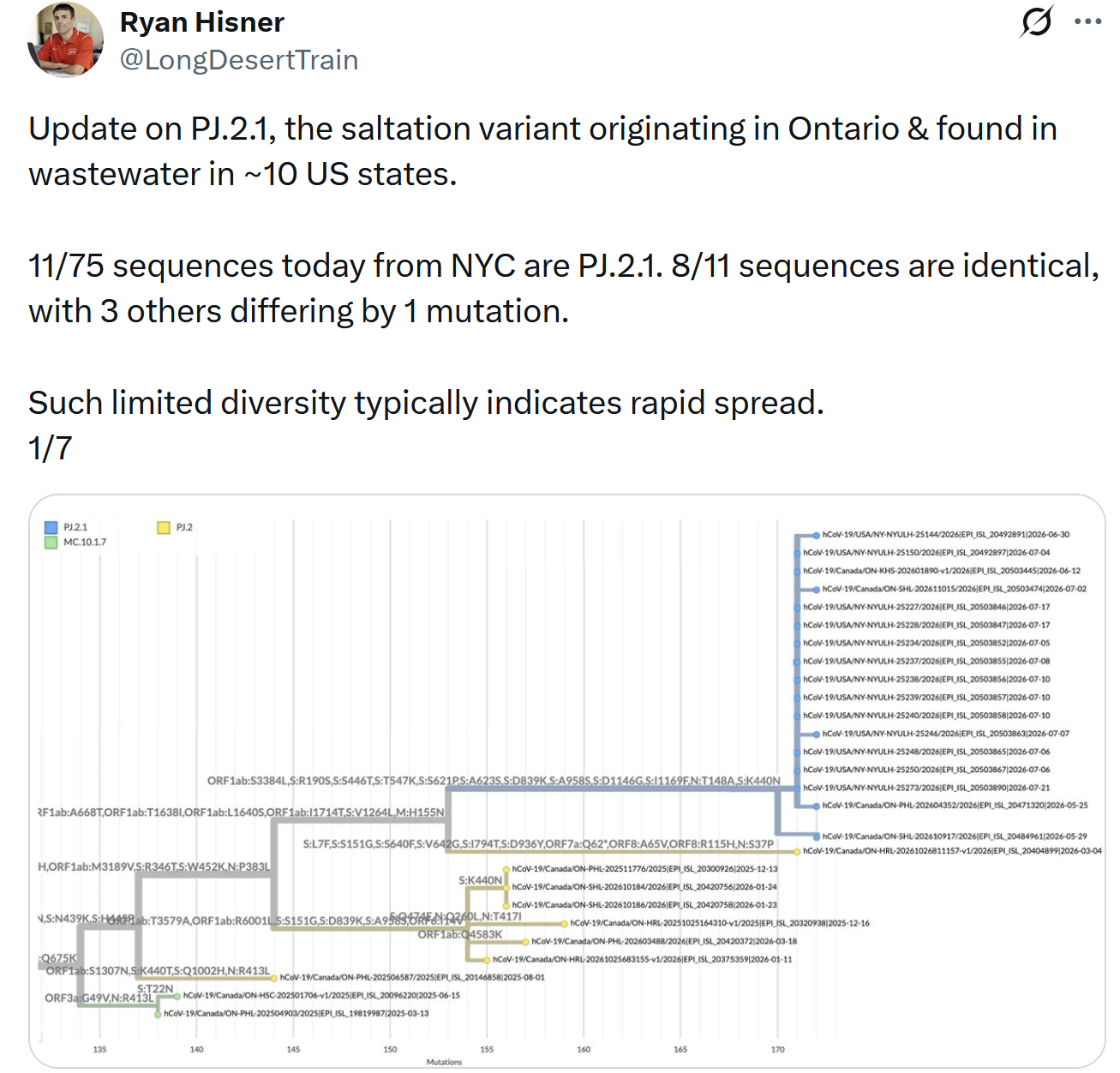
Figure 1B. Ryan Hisner’s updated PJ.2.1 phylogeny, 1 August 2026
A mutation is not automatically good or bad for a virus. Its effect depends on all the other mutations already present. This is called epistasis.
Imagine that a mutation helps the virus escape antibodies (Abs) but weakens its ability to bind to cells. At one stage that mutation may be too costly and disappear. Later, however, the virus may acquire other mutations that make cell binding much stronger. The formerly costly escape mutation can then become affordable.
This is why PJ.2.1 is interesting. Experiments suggest that it has exceptionally strong ACE2 binding but is not yet unusually Ab evasive. In simple terms, it may possess 'fitness capital' that could later be spent on immune escape.
Seasonality certainly matters. Weather, indoor crowding, school terms and humidity can all affect transmission. But I do not think these factors are enough to explain the present picture.
First, SC-2 has never settled into a clean winter-only pattern. WHO itself has described its circulation as lacking a clear seasonal or evolutionary pattern.
Second, in Belgium SC-2 wastewater levels rose from a very low baseline to 'high' while influenza and RSV were still low. In Europe, SC-2 activity began rising while other major respiratory viruses remained near baseline. In the United States, COVID-19 (C-19) activity increased during the summer and remained elevated in September even while overall respiratory illness, flu and RSV activity stayed low.
So seasonality may be helping the virus spread but the more important question is whether the virus population itself is also changing. A seasonal explanation describes a change in the environment. My hypothesis concerns a change in the virus population doing the transmitting.
What concerns me is therefore not simply the size of the present wave. It is the combination of renewed transmission with an unusually branched and experimentally active evolutionary landscape.
When the effect of one mutation depends on several others elsewhere in the genome, looking at mutations one by one becomes less informative.
The problem is no longer simply identifying the trees. The forest itself is changing shape.
A confusing collection of lineages may not mean the virus has no direction. It may mean that it is exploring many possible routes until one genetic combination opens a pathway that was previously blocked.
I remain particularly interested in whether the virus will increasingly use sugar structures on spike (S) protein ‒ glycans ‒ to hide important regions from immune recognition while preserving infectivity (https://www.voiceforscienceandsolidarity.org/scientific-blog/predictions-gvb-on-evolution-c-19-pandemic)
O-glycosylation near the receptor-binding region has been observed experimentally, although it is often weak and highly dependent on S structure. More firmly established work shows that a new N-linked glycan at N354 can change S conformation, immune recognition, fusion and other fitness properties.
So I would not claim that new O-glycosylation is already driving today's wave. I would call it a mechanistic prediction worth watching very carefully.
My model can be pictured as a golf ball sitting in a shallow valley. For a long time, many mutations may move the ball around without allowing it to escape the valley. Epistasis gradually changes the shape of the landscape. Eventually a route that used to be too costly may become crossable.
That is what I mean by a possible ‘phase transition’. We are not yet entitled to say the ball has rolled down the other side. Hospitalizations and disease severity do not show a convincing new global pattern.
But I think there is now more reason to ask whether the ball is approaching the edge. The virus population is highly branched. Saltation variants continue to appear. Some genetic backgrounds may now compensate costs that previously blocked strong immune-escape mutations. And transmission is increasing from very low baselines in several places.
That is the kind of configuration I would expect near the boundary of a metastable state.
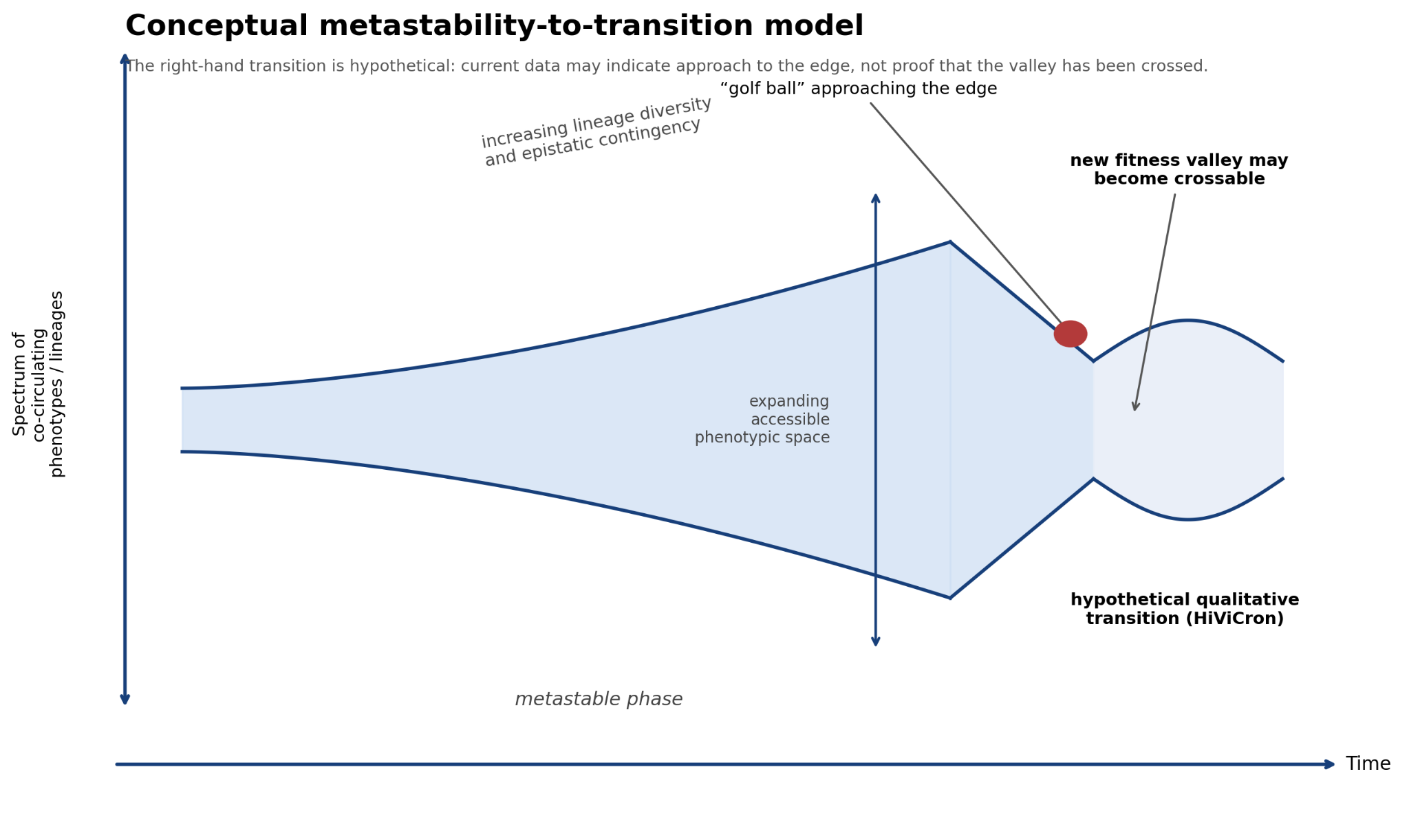
Conceptual figure. As the range of viable SC-2 variants widens, epistatic compensation may eventually make a previously inaccessible evolutionary route crossable. This is a hypothesis, not an observed phylogeny.
If the present rise fades while the lineage landscape settles, without further evidence of faster lineage replacement, stronger immune escape, altered glycan use or increasing clinical severity, then the seasonal explanation becomes more convincing. Conversely, repeated appearance of compensatory immune-escape mutations on highly fit backgrounds, accelerating lineage replacement or a new clinical phenotype would strengthen the phase-transition interpretation.
· Transmission signal: YES.
· Unusual evolutionary signal: YES.
· Evidence that seasonality alone explains it: NO.
· Proof of a global phase transition: NOT yet.
· Convincing increase in virulence: NOT yet.
1. Ryan Hisner, PJ.2.1 / Neher-Roemer phylogeny, 21 July 2026
2. Ryan Hisner, updated PJ.2.1 tree, 1 August 2026
3. He P et al. Increased receptor binding capability of PJ.2.1, bioRxiv, 2026
5. WHO Global Respiratory Virus Activity, Weekly Update 597
6. ECDC SARS-CoV-2 variants, 25 September 2026
7. Sciensano Belgium wastewater surveillance
8. CDC Respiratory Illnesses Data Channel
9. Liu P et al. N354 glycosylation, National Science Review

Geert Vanden Bossche received his DVM from the University of Ghent, Belgium, and his PhD degree in Virology from the University of Hohenheim, Germany. He held adjunct faculty appointments at universities in Belgium and Germany. After his career in Academia, Geert joined several vaccine companies (GSK Biologicals, Novartis Vaccines, Solvay Biologicals) to serve various roles in vaccine R&D as well as in late vaccine development.
Geert then moved on to join the Bill & Melinda Gates Foundation’s Global Health Discovery team in Seattle (USA) as Senior Program Officer; he then worked with the Global Alliance for Vaccines and Immunization (GAVI) in Geneva as Senior Ebola Program Manager. At GAVI he tracked efforts to develop an Ebola vaccine. He also represented GAVI in fora with other partners, including WHO, to review progress on the fight against Ebola and to build plans for global pandemic preparedness.
Back in 2015, Geert scrutinized and questioned the safety of the Ebola vaccine that was used in ring vaccination trials conducted by WHO in Guinea. His critical scientific analysis and report on the data published by WHO in the Lancet in 2015 was sent to all international health and regulatory authorities involved in the Ebola vaccination program. After working for GAVI, Geert joined the German Center for Infection Research in Cologne as Head of the Vaccine Development Office. He is at present primarily serving as a Biotech / Vaccine consultant while also conducting his own research on Natural Killer cell-based vaccines.
Email: info@voiceforscienceandsolidarity.org
.svg)
